


21 May Laboratory Design – The Psychology of Scientific Performance
How Laboratory Environments Influence Focus and Performance
When people think about scientific innovation, they usually picture the individuals behind the discoveries — researchers analysing data, scientists working late into the evening or engineers developing new technologies.
What is often overlooked is the environment where this work takes place.
In commercial laboratories, the workspace itself plays a significant role in how teams operate. Laboratory design can influence concentration, workflow, collaboration, safety and even problem-solving performance.
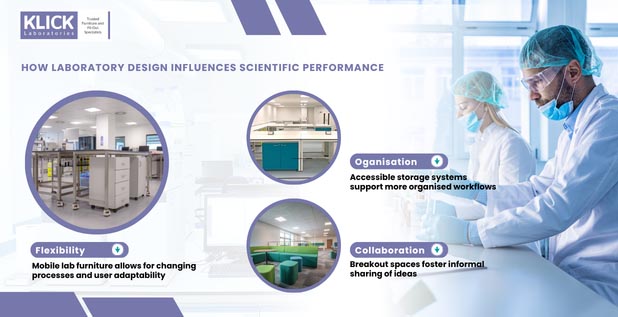
At Klick, we understand that laboratories are far more than technical spaces filled with equipment. They are environments designed around people — and the quality of those environments can directly affect how effectively scientific teams work.
“Structure doesn’t restrict innovation — it creates the conditions for it.”
Why Laboratory Design and Layouts Matter
Modern laboratories are carefully planned around workflow and functionality. Different activities require different environments, whether that involves:
- Analytical testing and sample preparation
- Collaborative research and write-up spaces
- Specialist equipment zones
- Clean and controlled environments
- Storage and utility areas
- Focused technical workstations
A well-planned laboratory layout improves operational efficiency, but it also supports how people think and behave within the space.
Research into workplace psychology suggests that environments influence concentration, communication and decision-making. Clear zoning and intuitive layouts help reduce cognitive overload and create more focused, productive working environments.
In busy commercial laboratories, this can support:
- Smoother movement between different laboratory processes and functions
- Improved collaboration between scientific and technical teams
- Safer circulation throughout the workspace
- Reduced disruption and operational bottlenecks
- More efficient use of equipment, utilities and storage
The most effective laboratory environments quietly guide people through the space without them even noticing.
Precision Science Requires Precision Environments
One of the most famous scientific images ever produced was Photo 51 — Rosalind Franklin’s X-ray diffraction image that helped unlock the structure of DNA.
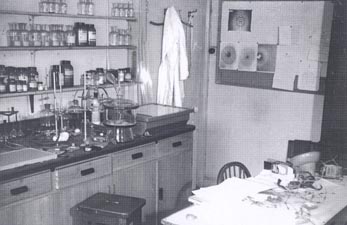

Franklin’s work relied not only on expertise and technical skill, but also on highly controlled laboratory conditions and specialist imaging environments.
Images of Franklin’s laboratory spaces at Birkbeck and King’s College London demonstrate how important organisation, workflow and technical precision were to the scientific process.
The principle remains highly relevant today. Whether in pharmaceutical, healthcare, industrial or research laboratories, the surrounding environment can significantly influence accuracy, consistency and concentration.
Laboratory Design Has Evolved Beyond Pure Function
Historically, many laboratories were designed almost entirely around practicality — white walls, uniform surfaces and highly clinical interiors.
Today, commercial laboratory environments are evolving.
Modern facilities increasingly incorporate:
- Ergonomic workstations that support long-term comfort
- Improved lighting design to reduce fatigue and support concentration
- Collaborative breakout spaces for informal discussion and idea sharing
- Improved circulation and visibility between work areas
- Adaptable layouts designed to accommodate future operational changes
- Use of highlight blues and greens that support calm focus and reduce fatigue
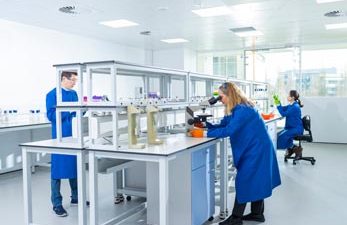
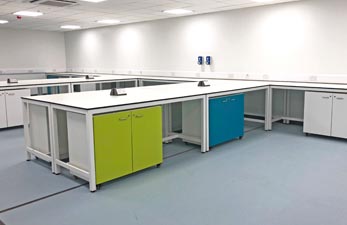
This shift is not simply about aesthetics.
Studies into workplace psychology suggest that colour, lighting and materials can affect:
For laboratory professionals spending long hours in technical environments, these factors matter.
Well-designed spaces help create calmer, more comfortable environments that support sustained focus and high-performance working.
How Laboratory Furniture Design Influences Behaviour
Laboratory furniture does more than support equipment — it shapes how people interact with the space around them.
Subtle design decisions can influence behaviour every day:
- Standing-height benches can encourage collaboration and side-by-side working between teams
- Accessible storage systems reduce unnecessary movement and support more organised workflows
- Spacious layouts improve circulation and reduce congestion around shared work areas
- Clear sightlines improve visibility, supervision and communication throughout the laboratory
- Well-lit workspaces can help reduce error rates and support concentration during technical tasks
Effective lab design is often about removing friction from the working day.
When workspaces feel intuitive and organised, teams can focus more fully on scientific work rather than navigating operational obstacles.
Designing Research Labs for Performance and Adaptability
Research laboratories often require highly specialised environments that balance technical functionality with flexibility and long-term usability.
Effective research lab design may involve consideration of:
- Workflow between analytical and preparation processes
- Specialist ventilation and extraction requirements
- Integration of utilities, reagent shelving and service distribution
- Ergonomic workstation design for repetitive technical tasks
- Future adaptability for changing equipment or research priorities
- Cable management and integrated data connectivity
- Adjacent write-up, collaboration and breakout spaces
Well-designed laboratory furniture can also significantly improve operational efficiency. Carefully positioned utilities, organised storage and adaptable layouts help support smoother day-to-day workflow and reduce disruption.
Flexibility has become increasingly important in modern scientific environments. Many commercial laboratories now require spaces that can evolve alongside changing technologies, research priorities and team structures.
Features such as:
- Mobile laboratory furniture
- Modular benching systems
- Adaptable layouts
- Collaborative breakout spaces
Have the effect of allowing laboratories to evolve without requiring complete redesign every time operational needs change.
Clients have benefitted from Klick Technology’s flexible approach to laboratory fit-out projects which has the advantage of providing a facility that can adapt to changes in operational needs.
Bell Laboratories and the Power of Collaborative Spaces
Bell Labs remains one of the most influential research organisations in history, contributing to developments including the transistor and advances in telecommunications.
Part of Bell Labs’ success came from the way its buildings were designed.
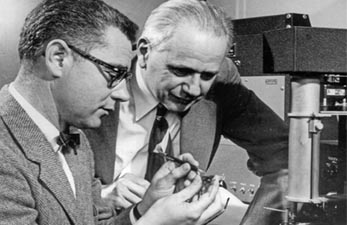
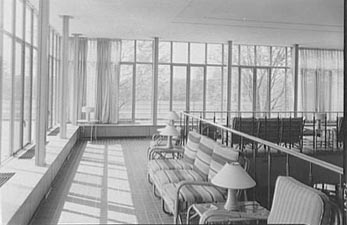
Today, these would be described as breakout or collaboration spaces — areas intentionally designed to encourage communication and the sharing of ideas.
Innovation often happens during spontaneous conversations and informal collaboration just as much as through structured meetings.
The principle remains highly relevant in modern commercial laboratories where interdisciplinary working and knowledge sharing are increasingly important.
Laboratory Safety Starts With Good Design Principles
Safety in laboratories is not only about PPE, procedures or signage. It is also influenced by how intuitive and functional the environment feels to use.
Good lab design supports safer behaviour through:
When spaces feel organised and predictable, people naturally work more confidently and safely.
This is particularly important within live operational laboratories where workflow efficiency and compliance requirements must work alongside day-to-day operational pressures.
Medical and healthcare laboratory environments introduce additional design considerations due to the importance of:
- Hygiene and infection control
- Efficient sample handling
- Durability under intensive daily use
- Easy-clean and chemical-resistant surfaces
- Ergonomic workstation design
- Integrated sinks, utilities and storage systems
When designing medical laboratory furniture solutions careful planning can help reduce unnecessary movement between preparation, testing and administration areas — supporting both efficiency and staff wellbeing.
Real-World Laboratory Design: Biofortuna Ltd, Deeside
A good example of how laboratory environments can support workflow and operational performance is Klick Technology’s laboratory construction and installation project for Biofortuna in Deeside.
Biofortuna operates within the healthcare and diagnostics sector, where laboratory environments must balance:
- Technical performance
- Workflow efficiency
- Durability
- Compliance requirements
- Future adaptability
The project involved the creation of specialist laboratory spaces designed around the operational requirements of the client and the day-to-day needs of laboratory users.
Key considerations included:
- Efficient workflow between laboratory functions and processes
- Integration of specialist laboratory furniture and services
- Durable and chemical-resistant work surfaces
- Effective storage and workspace organisation
- Layouts designed to support both focused technical work and team collaboration
- Flexibility to accommodate evolving operational requirements
As with many modern laboratory environments, the project demonstrated that successful lab design is not simply about fitting equipment into a room. The environment itself becomes part of the operational process — supporting how people move, communicate, focus and work within the space.

Why Creativity and Innovation Depend on Structured Design
There is a common assumption that innovation thrives in chaotic environments. In reality, research often suggests the opposite.
Well-organised spaces reduce unnecessary distractions and allow teams to focus more effectively on:
- Analysis and experimentation
- Collaboration and communication
- Technical development
- Problem solving
- Identifying new opportunities and ideas
Reliable environments create the stability needed for creative thinking.
Designing Laboratory Spaces Around Scientist’s Needs
At Klick Technology, we believe successful lab design starts with understanding how people use a space.
Whether delivering laboratory refurbishment projects, fit-outs or specialist laboratory furniture solutions, thoughtful planning around:
- Workflow and operational efficiency
- Ergonomics and comfort
- Collaboration and communication
- Storage and organisation
- Visibility and circulation
- Durability and flexibility
The most effective laboratories are not simply technically compliant spaces — they are environments designed to support the people working within them every day.
Because every innovation begins somewhere, and the environment behind it matters more than we often realise.
Key Takeaways For Lab Design That Supports Creative Science
- Laboratory environments directly influence workflow, concentration and collaboration
- Flexible layouts help commercial laboratories adapt to changing operational requirement
- Ergonomic laboratory furniture can improve both efficiency and user comfort
- Collaboration spaces support communication and interdisciplinary thinking
- Well-designed laboratories improve safety, circulation and organisation
- Effective lab design supports both technical performance and innovation
Klick Technology delivers laboratory refurbishment and fit-out solutions designed around workflow, collaboration, durability and long-term flexibility.
From research laboratories and innovation spaces through to healthcare and specialist scientific environments, we work closely with clients to create practical, high-performing laboratory spaces tailored to operational needs.
If you are planning to update your laboratory design feel free to get in touch by email or call 0161 998 9726 if you have a project you would like to discuss.
Thanks Clare Whitehurst
Further Reading
The Francis Crick Institute – Lab Design & Collaboration
Royal Society – Science and the Working Environment
Related sources:
Rosalind Franklin’s laboratory at Birkbeck College