Why Your Laboratory Worktop Specification Matters
The worktop is the single most used surface in any laboratory. It takes the spills, the heat, the heavy equipment and the daily clean-down and you cannot easily change it once the benching is installed.
The worktop specification is not always the top priority for clients at design stage but it plays a critical role in lab functionality.
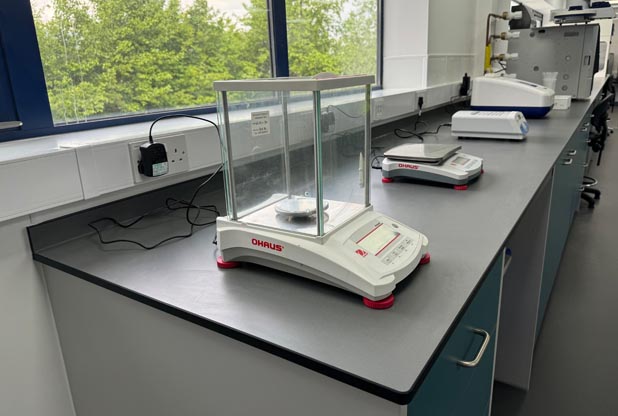
The importance of choosing the right worktop material often becomes apparent over time. It shows up two years later as staining around the sink, blistering next to a hotplate or a surface that no longer cleans up properly. Choosing well means a laboratory worktop that still looks and performs as specified after a decade of use.
This guide compares the materials we specify most often for UK laboratories and school science labs, what each one is genuinely good at and where each one struggles.
Laboratory Worktop Materials at a Glance
| Trespa TopLab BASE | Trespa TopLab PLUS ALIGN | Stainless Steel | Velstone | |
|---|---|---|---|---|
| Material type | High-pressure laminate | High-pressure laminate | 304 or 316 grade steel | Solid surface |
| Chemical resistance | Good | Excellent | Good, but poor against chlorides | Moderate |
| Heat resistance | Moderate | Moderate | Excellent | Moderate |
| Repairable on site | No | No | Limited | Yes |
| Seamless joints | No | No | Welded | Yes |
| Typical use | School science labs, general purpose | Chemistry, research, sterile areas | Cleanrooms, food and drink, catering, pathology | Medical, sterile, front-of-house labs |
Trespa: The Default for Most Laboratories.
Trespa is a high-pressure laminate made from wood-based fibres and phenolic resin, compressed under heat into a solid panel. It is fabricated from 16mm solid grade board and generally fitted with a 50mm upstand to perimeter benching.
It is the industry standard for most laboratory environments, and for good reason — it balances chemical resistance, durability and cost better than anything else available. Klick specify two grades, and the difference between them matters more than most specifications acknowledge.
Trespa TopLab BASE
- Robust where scratch and wear resistance are the priority
- Easy to clean and suitable for contact with food
- Ideal for educational environments and general-purpose labs where chemical exposure is limited
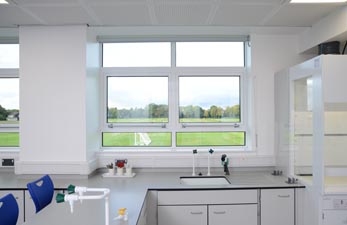
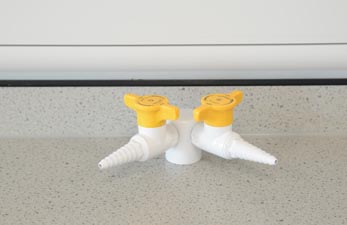
BASE is the right answer for the overwhelming majority of school science laboratories. A secondary school chemistry lab sees dilute acids and thirty pairs of hands per lesson. The realistic threats are scratching, impact and everyday wear, not aggressive solvents — and BASE handles those extremely well.
Trespa TopLab PLUS ALIGN
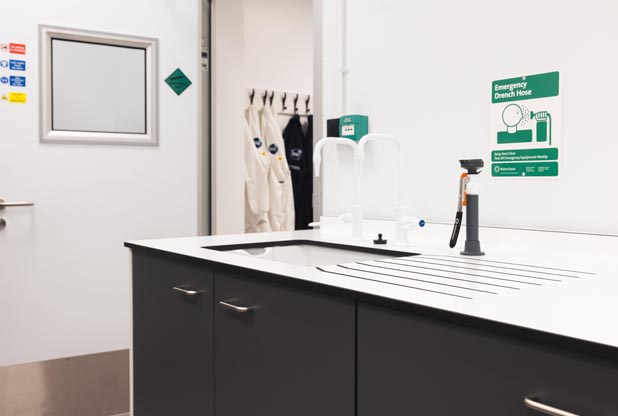
- Highly resistant to a wide range of aggressive chemicals
- Non-porous surface that does not support bacterial growth
- 85% bio-based carbon content, supporting renewable material commitments
- Suits sterile environments and labs handling corrosive substances
PLUS ALIGN is the specification for research, pharmaceutical and analytical laboratories and increasingly for organisations with sustainability targets attached to their procurement. If your COSHH assessment lists concentrated acids, strong solvents or anything that will sit on a surface for more than a moment, this is the grade to specify.
Where Trespa struggles: sustained direct heat. Trespa is not the surface for an unprotected hotplate, a Bunsen burner used without a heat mat or a muffle furnace. It also cannot be repaired in place — damage means replacing the panel.
Stainless Steel: Cleanability Above All
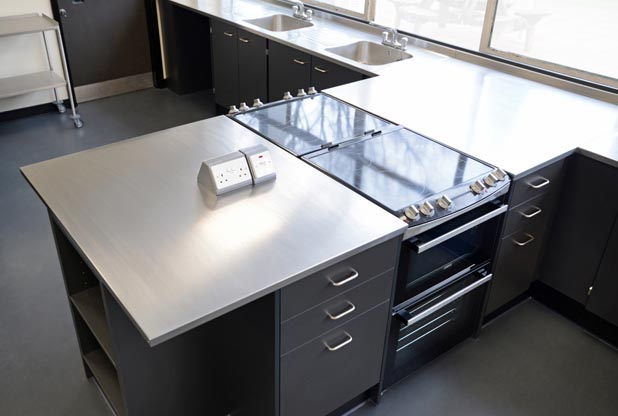
- Withstands high temperatures without protection
- Non-porous with welded seamless joints and coved upstands
- Cleans and sterilises to a standard other materials cannot match
- Suits cleanrooms, food and drink laboratories, catering, pathology and medical environments
Grade matters. 304 is the general-purpose specification; 316 adds molybdenum and significantly better resistance in saline and chloride-rich conditions. Specifying 304 where 316 was needed is one of the more expensive mistakes in a lab fit-out, and it is not visible until pitting appears.
Where stainless struggles: it scratches and shows every mark, which unsettles clients who expect it to look pristine. It is also poor against hydrochloric acid and chlorides — which surprises people who assume stainless resists everything. It is noisy, cold to work on and reflects light in a way that can be tiring in a lab where staff spend all day at the bench.
Velstone: Seamless and Repairable
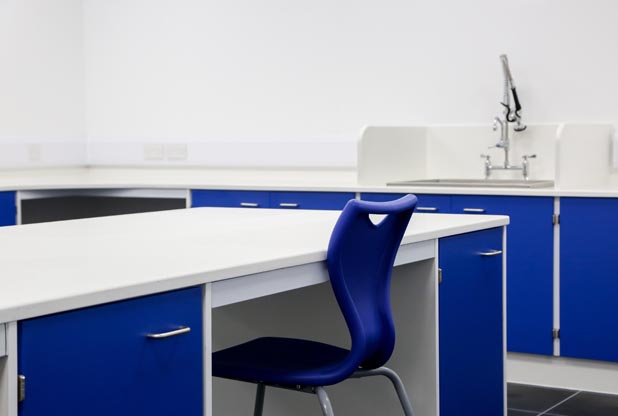
- Non-porous, helping prevent bacterial growth
- Joints can be bonded invisibly, giving a continuous run with no seams to trap contamination
- Scratches and stains can be removed on site, and accidental damage is repairable in place
- Strong aesthetic appeal where the lab is seen by clients, visitors or patients
That on-site repairability is Velstone’s real advantage. Every other material on this list requires a replacement panel when it is damaged — with the disruption and lead time that involves. Velstone can be brought back to as-new by an operative in an afternoon.
It suits medical and pathology laboratories, sample reception areas and any lab that forms part of a building’s public face.
Where Velstone struggles: it is not the choice for aggressive chemistry or sustained heat. Specify it for the environment it suits, not as a general-purpose surface.
What About Standard Laminate?
Standard laminate and melamine-faced boards appear regularly in refurbishment enquiries, usually because a budget is tight or because an existing room has them.
However they are entirely appropriate for cabinet carcasses and doors — Klick supply FSC-certified MDF and melamine-faced chipboard (MFC) as standard, and MFC’s strength and scratch resistance meet EN14323.
They are not appropriate for laboratory worktops. Standard laminate is a thin decorative layer over a porous substrate. Once the edge or surface is breached, moisture reaches the core and the failure is progressive and irreversible. In a school science lab, that point arrives within a few years.
If budget is the constraint, Trespa TopLab BASE is the honest lower-cost specification — not laminate.
Choosing by Laboratory Type
School science laboratories — Trespa TopLab BASE for general teaching. Consider PLUS ALIGN for a dedicated chemistry preparation area and use heat mats regardless of the material.
University and research laboratories — Trespa TopLab BASE as standard with Trespa TopLab PLUS ALIGN in chemistry-heavy areas.
Pharmaceutical, cleanroom and sterile environments — Trespa PLUS ALIGN or stainless steel, depending on the classification and the cleaning regime. Coved details and minimal joints matter as much as the surface itself.
Food and drink laboratories and catering kitchens — stainless steel in wet and preparation areas; Trespa BASE, which is safe for food contact, elsewhere.
Medical and pathology laboratories — Trespa TopLab BASE, Velstone or stainless steel, chosen on whether repairability or sterilisation takes priority.
Design and technology, art and food technology rooms — Trespa BASE, with stainless steel for wet areas and preparation stations.
Five Questions to Ask Before You Specify
- What actually goes on this surface? Not what the room is called – what the COSHH assessment says will be in contact with it.
- Where is the direct heat? Identify every hotplate, burner and furnace position and specify locally around them.
- How is it cleaned and how often? Daily disinfection with harsh agents is a materially different demand from a weekly wipe-down
- What happens when it gets damaged? Repairable in place, or a panel replacement with lead time and disruption?
- Who sees this lab? A lab on a client tour has a different brief from one behind a controlled door.
The Details That Outlast the Material Choice
Worktop failures usually start somewhere other than the middle of the bench.
Upstands — a 50mm upstand to perimeter benching stops water tracking down behind the units. Its absence is the most common cause of avoidable damage we see on site.
Edge profiles — square, radius or machined. A radius edge is more comfortable for staff standing at the bench all day and less prone to chipping.
Joints — every joint is a potential entry point. Minimising and positioning them away from wet areas matters more than the material’s headline chemical resistance.
Sinks and drainers — whether the sink is integral, under-mounted or top-mounted determines how the junction performs over time. Drainer grooves machined into the worktop shed water without an added component.
Case Study Example – Worktops Do Not Work Alone
Our laboratory refurbishment for Cyprotex is a useful illustration. It shows worktop specification alongside heavy equipment and intensive laboratory use, with bespoke workstations designed for equipment weighing up to 250kg.
It demonstrates why a worktop should never be specified in isolation. The worktop, supporting framework, equipment loading, vibration and overall workstation design all need to be considered together.
Worktop Final Thoughts: Specify for the Work, Not the Room
There is no single best laboratory worktop material. There is a right material for the chemistry, the heat, the cleaning regime and the people doing the work — and getting that match right is what determines whether the surface still performs in ten years.
In some cases a single specification across an entire facility will mean one area is over-specified and another is quietly under-protected.
Testimonial
“At the initial stages of the 2 year design phase, Klick built prototypes of the bespoke furniture items for testing and investigated alternative worktop materials. They refined the layouts for each of the laboratories and produced 3D CAD drawings to illustrate the new designs, giving us confidence in the final product.”
DANIEL WALDER – Associate Architect, BDP
Not sure which worktop specification suits your laboratory? Our laboratory design team offers a free, no-obligation consultation and site visit. We will look at the work your lab actually does, review your existing facilities and advise on the right worktop specification area by area – before anything is committed to a drawing.
Call 0161 998 9726 or contact us by email to arrange a visit.
Sources:
As with many modern laboratory environments, the project demonstrated that successful lab design is not simply about fitting equipment into a room. The environment itself becomes part of the operational process — supporting how people move, communicate, focus and work within the space.
Klick Technology delivers laboratory refurbishment and fit-out solutions designed around workflow, collaboration, durability and long-term flexibility.
From research laboratories and innovation spaces through to healthcare and specialist scientific environments, we work closely with clients to create practical, high-performing laboratory spaces tailored to operational needs.
If you are planning to update your laboratory design feel free to get in touch by email or call 0161 998 9726 if you have a project you would like to discuss.
Thanks Clare Whitehurst
Further Reading
The Francis Crick Institute – Lab Design & Collaboration
Royal Society – Science and the Working Environment
Related sources:
Rosalind Franklin’s laboratory at Birkbeck College